


Ready for the easiest way to cook moist Thanksgiving turkey? Make Dry Brine Turkey! Rub kosher salt, rosemary, and lemon zest on the bird a few days in advance for a flavorful, juicy bird with golden skin. I’ve been using this method for 15 Thanksgivings. With more than 170 glowing reader reviews, you know it works!

The Best Thanksgiving Turkey Starts with Brining
Dry brining is the process of rubbing salt (here, with rosemary and lemon zest) on the turkey and letting it rest in the fridge before cooking. Here are the basics for quick reference:
- How much salt: Use 1 tablespoon Morton kosher salt (or 1¾ tablespoons Diamond Crystal) for every 5 pounds of turkey. See the chart below for your size bird.
- How long to brine: At least 36 hours—24 hours with the bird covered in the fridge, then 12 hours uncovered so the skin dries and can crisp.
- Do I rinse a dry brine? No. You do not need to rinse or brush off a dry brine. Simply cook the turkey as is.
Have less than 36 hours or prefer a traditional wet brine? Check out our wet Turkey Brine recipe.
5 Star Review
“I have tried many brines – wet and dry – but this is THE BEST! My 3rd year making it and turned out perfect!”
— Holly —

Why Brine a Turkey?
During brining, the structure of the meat transforms.
- Salt draws out the meat’s juices, dissolves into them, and then is reabsorbed.
- Once reabsorbed, it breaks down the meat, making it more tender.
- Brining seasons the meat from within so it has flavor all the way through, not just on the outside.
- Brined meat can better retain moisture.
Result: an ultra juicy, tender turkey with succulent flavor throughout.
If your turkey has dried out in the past, it likely was not brined (or not brined for long enough), or it was overcooked. An instant-read thermometer will save you from overcooking (see How Long to Cook a Turkey for details), and this post has everything you need to brine like a boss.

Dry Brine vs. Wet Brine
A wet brine submerges the turkey in a saltwater solution that is flavored with spices, herbs, and other aromatics like citrus peels for 12 to 24 hours. (This is the best wet brine turkey recipe.)
For a dry brine, a mixture of kosher salt and other herbs/spices is rubbed on the outside of the turkey, which then rests in the fridge.
Nine times out of 10, I prefer a dry brine over a wet brine.
- A dry brine is easier than a wet brine. All you do is mix up the brine, then rub it on the turkey skin. There’s no worry about boiling, submerging, etc.
- A dry brine is less messy than a wet brine. You don’t need to pour gallons of liquid in or out of a stock pot and bucket.
- No special equipment. You can brine the turkey right on a regular rimmed baking sheet; no bucket or bag required.
- No need to rinse. Unlike a wet brine, you don’t need to rinse dry brine off of the turkey, saving you a messy step.
The downside of a dry brine is time. It needs at least 36 hours (24 hours covered, plus 12 hours uncovered).
If you have less time, make a wet brine instead. Wet-brined turkey is a touch more plump, but both make an excellent, juicy bird.

Tip!
For a visual of dry brine vs. wet brine, see this Baked Chicken Breast post. I tested both brining methods and took a photo of each so you can compare them side by side.

Dry Brine Ingredients
- Turkey. Because you will be salting the turkey yourself, avoid kosher turkeys, which are pre-salted, and self-basting turkeys, which are injected with a salt solution. (Already have a Butterball or pre-brined turkey? See below for how to brine it.)
- Kosher Salt. Yes, the type of salt you use does matter. I used Morton kosher salt. Using kosher salt is non-negotiable, as table salt isn’t coarse enough and will make your turkey taste metallic. If you use Diamond Crystal brand kosher salt, use 1¾ times the amount of Morton.
- Rosemary. One of the best herbs with turkey! Chopped fresh rosemary gives the turkey skin a cozy, earthy flavor that is perfect for the season.
- Lemon Zest. To give the turkey brightness. Lemon pairs well with rosemary.
Tip!
If you aren’t sure if your turkey has been salted, just check the ingredients. You shouldn’t see salt listed.
How Much Salt for Your Turkey
My recipe is written for a 14- to 16-pound turkey. For a smaller or larger bird, use the chart below. The rule of thumb is 1 tablespoon Morton kosher salt (or 1¾ tablespoons Diamond Crystal) for every 5 pounds of turkey.
| Dry Brine Salt Amounts by Turkey Weight | ||||
|---|---|---|---|---|
| Turkey Weight | Morton Kosher Salt | Diamond Crystal Kosher Salt | Fresh Rosemary | Lemon Zest |
| 10 to 12 lb | 2 to 2½ Tbsp | 3½ to 4¼ Tbsp | 1 to 1¼ Tbsp | 1 small lemon |
| 13 to 16 lb | 3 Tbsp | 5¼ Tbsp | 1½ Tbsp | 2 small or 1 large |
| 17 to 20 lb | 3½ to 4 Tbsp | 6 to 7 Tbsp | 1¾ to 2 Tbsp | 2 small |
| 21 to 24 lb | 4¼ to 4¾ Tbsp | 7½ to 8½ Tbsp | 2 to 2½ Tbsp | 2 to 3 small |
How to Dry Brine a Turkey


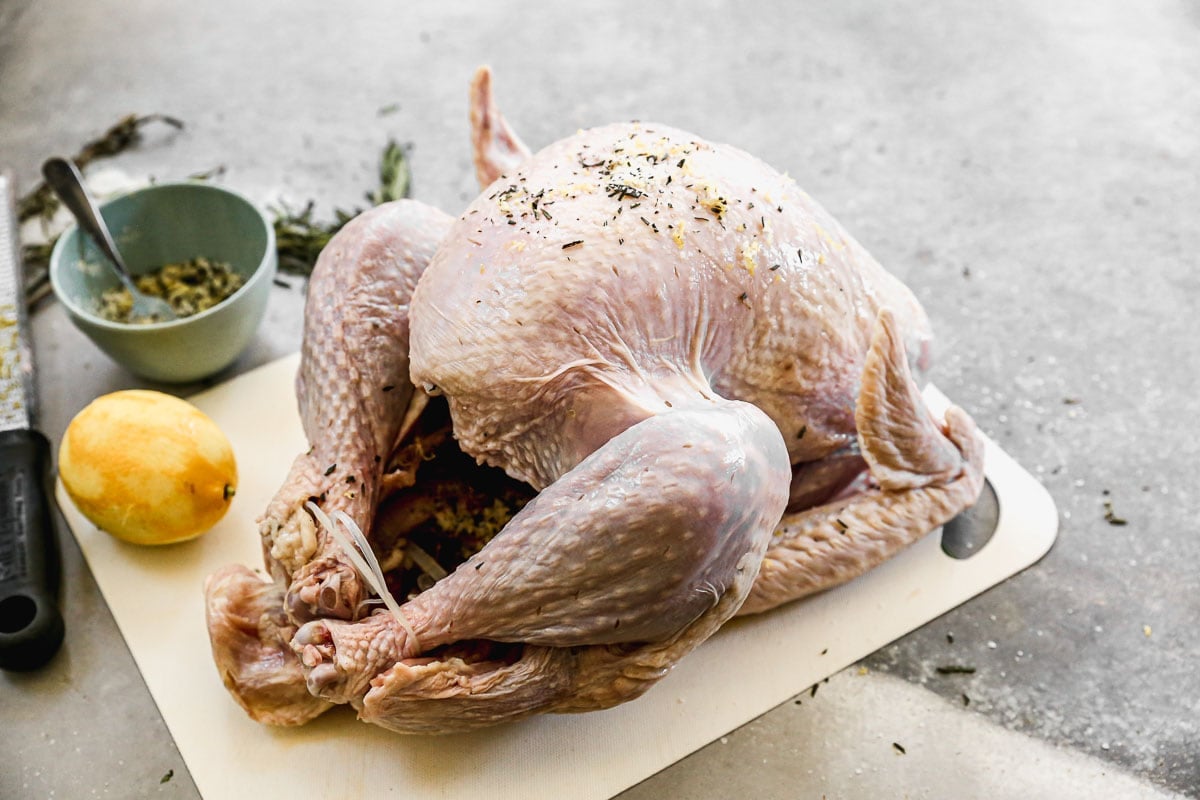
Prepare. Thaw your turkey completely in the refrigerator (see How Long to Cook a Turkey for tips).
Make the Brine. Mix all the dry brine ingredients in a small bowl.
Brine the Turkey. Pat the turkey dry. Sprinkle some brine inside the cavity, then rub the rest on the outside. You do not need to loosen the skin and rub salt underneath it.
Cover and Refrigerate. Cover the turkey with plastic wrap (I cover the entire sheet pan) and refrigerate for at least 24 hours. It’s normal for some liquid to collect on the pan.
Uncover to Dry the Skin. Remove the plastic and let the turkey sit in the fridge for at least 12 hours. The skin will turn slightly translucent, meaning it’s ready to crisp in the oven.
Get Ready to Cook. Let the turkey come to room temperature 1 hour before cooking. Do not rinse or brush off the dry brine. ENJOY!
Meal Prep Tip
Up to 1 day before brining the turkey, prepare the brine mixture as directed. Cover and refrigerate the brine until you’re ready to use it.
Dry Brine Turkey Timeline
Here is how I time my Thanksgiving for a 15-pound turkey.
- Friday or Saturday before Thanksgiving: Start thawing (if your turkey is frozen). Move the turkey to the fridge, placing it on a rimmed sheet pan to catch any drips. Plan 24 hours thawing for every 4 to 5 pounds of turkey.
- Tuesday: Brine. Rub on the dry brine, cover, and refrigerate (you can do this Monday as well, as long as your turkey is thawed).
- Wednesday: Uncover. Remove the plastic wrap and return the turkey to the fridge.
- Thursday: Roast! Remove the turkey from the refrigerator 1 hour prior to cooking, then roast.

Can You Dry Brine a Butterball, Kosher, or Pre-Brined Turkey?
Kosher turkeys and pre-brined or self-basting turkeys (like many Butterballs) have already been salted, so a full dry brine will make them too salty. To check, read the label. If you see salt or “contains up to X% solution,” your turkey has been pre-salted.
For kosher turkeys and pre-brined turkeys that are a brand other than Butterball, skip the salt, rub on the rosemary and lemon zest, and let the skin dry uncovered in the fridge for 24 hours.
For Butterball turkeys specifically, I find the injected brine isn’t enough to make the turkey sufficiently flavorful or juicy. I use half the amount of salt, along with the full amount of lemon zest and rosemary.
Cooking Methods for Dry Brine Turkey
Once your turkey is brined, you can cook it any way you like. Remember, don’t rinse it and don’t add more salt.
- Roast it: How to Cook a Turkey
- Spatchcock it: Spatchcock Turkey
- Smoke it: Smoked Turkey
A few friendly reminders: Cook to temperature, not time, and use an instant-read thermometer. See How Long to Cook a Turkey for a chart by weight and temperatures.
Use This Dry Brine on Other Meats
This dry brine works well with other cuts of meat, especially pork and poultry. Try it with Baked Chicken Breast, Grilled Pork Chops, Baked Pork Tenderloin, or Baked Chicken Thighs.
Dry Brine Turkey
Video
Email Me the Recipe!
From time to time, we’ll send you Well Plated emails. You can unsubscribe anytime. Have an account? Log In.
Ingredients
- 1 14- to 16-pound turkey* thawed (see step 1 for guidance)
- 3 tablespoons kosher salt** I use Morton's (or 5¼ tablespoons Diamond Crystal)
- 1 ½ tablespoons minced fresh rosemary
- Zest of 2 small or 1 large lemon Reserve the zested lemons for stuffing the turkey if desired
Instructions
- 5 to 7 Days Before Cooking (depending upon weight) – Thaw Your Turkey (if needed): Place the turkey in the refrigerator for 24 hours for every 4 to 5 pounds of turkey (that's 3 to 4 days thawing for a 15-pound bird).
- 2 to 3 Days Before Cooking – Brine the Turkey: In a small bowl, combine the salt, rosemary, and lemon zest. Remove the neck and giblets from the turkey and discard or keep for gravy. With paper towels, pat very dry (you do not need to rinse the turkey; this has a greater chance of spreading bacteria than removing it). Transfer the turkey to a rimmed baking sheet or shallow baking pan. Sprinkle 1 tablespoon of the salt mixture inside the cavity.

- Rub the rest all over the outside of the turkey, including under the wings and the legs, and concentrating especially on the breast (no need to salt the very backside of the bird that is touching the pan or rub salt under the skin).
- Cover tightly with plastic wrap. Refrigerate for at least 24 hours and up to 48 hours.
- 1 Day Before Cooking – Let the Skin Dry Out: Uncover the turkey, then return it to the refrigerator. Refrigerate uncovered for at least 12 hours and up to 24 hours, until 1 hour before cooking. This step dries the skin, which is important in order for it to crisp. The skin will turn somewhat translucent.
- 1 Hour Before Cooking – Let Come to Room Temperature: Remove the turkey from the refrigerator and let stand at room temperature (do not brush off the brine). If you haven't removed the plastic "carrier" attached to the legs, do so now. Cook as desired. See How to Cook a Turkey, Spatchcock Turkey, and Smoked Turkey for cooking methods.


Notes
- IF YOU FORGOT TO THAW YOUR TURKEY: You can thaw it in cold water (about 30 minutes per pound, changing the water every 30 minutes), but USDA recommends cooking a turkey thawed this way right away. That means there’s no time to dry brine it. Skip the brine and go straight to How to Cook a Turkey.
- *MAKE SURE YOUR TURKEY IS NOT PRE-SALTED: Kosher turkeys (which are already salted) and many pre-brined turkeys will be far too salty if dry-brined. Look for a natural or heritage turkey; if you aren’t sure, check the ingredient list—you should not see added salt. If your turkey is pre-brined, you can still dry out the skin for 24 hours and use the lemon zest and rosemary (For Butterball turkeys specifically, I do still use salt, as I find the pre-injected amount isn’t sufficient to make the turkey flavorful and moist. I halve the amount in this recipe.)
- **USE KOSHER SALT: I used Morton’s kosher salt, which is coarser than table salt and has a much cleaner flavor. Do not use table salt, as it tastes metallic. If using Diamond Crystal, use 1¾ tablespoons for every tablespoon of Morton’s (5¼ tablespoons total for this recipe), since its flakes are lighter.
- SCALING THE BRINE FOR A LARGER OR SMALLER TURKEY: If your bird is smaller than 14 pounds or larger than 16 pounds, follow these guidelines: For every 5 pounds of turkey, use 1 tablespoon Morton kosher salt (or 1¾ tablespoons Diamond Crystal), 1½ to 2 teaspoons fresh herbs, and the zest of ½ a small lemon. See chart in the post above for specific amounts by turkey weight.
- FRESH VS. DRIED HERBS: I absolutely recommend using fresh herbs for turkey brine and roasting. They have far superior flavor and will make a big difference in your results; plus you need the sprigs for the cavity anyway. If you must substitute dried, use one-third the amount.
- Nutrition information was calculated for a 14-pound turkey.
- The total time for this recipe can vary based on the size of your turkey and whether or not it was fully thawed.


Hi Erin, I have your cookbook and love the recipes in it! I’m going to follow your recipe for dry brining because it sounds much better than some other recipes I’ve seen on Pinterest, and also because I trust your recipes. All of the other recipes that I’ve seen, say to brush off the salt before roasting. Would you please tell me the reason you say not to brush off the salt? Thank you.
Hi Joyce, we actually covered this a little in the blog post. It results in having an ultra juicy, tender turkey with succulent flavor throughout. If you are taking off the brine, then the full job of the brine isn’t finished. That happens when you cook the turkey. Hope this helps!
If you do the brine do you still rub butter all over the skin and under the skin before cooking?
Hi Elizabeth! No need to butter if you do the brine. That is an option if no brine is used. Hope you enjoy it!
Does this recipe say temperature of oven or how long per lb? I’m not seeing it.
Hi Susan! No, this recipe is just for the dry brine but we had it linked in the post. Here you go: https://www.wellplated.com/how-to-cook-a-turkey/
I made this with a full turkey last year, and it was great! This year I’ve opted to make another full bird as well as a bone-in turkey breast for the party size I’m hosting. Do you have any guidance for how to use this to cook a turkey breast? My hope is to roast it at the same time as the whole bird (though obviously for a shorter period of time). I’d love any guidance or suggestions you might have!
Also, I’ve been making your recipes for close to a decade now. You are my go to recipe blogger for sure. Thanks for great, healthy, easy meals!
Makes me so happy to hear, Erin! Thank you! In the post you’ll see the chart “Dry Brine Salt Amounts by Turkey Weight” so you can gauge how much to use for just a bone-in turkey breast. It will be based on the weight so you’ll have to start there. Also if you haven’t seen this recipe for our air fryer turkey breast, we give directions for bone-in and boneless. Hope this helps! https://www.wellplated.com/air-fryer-turkey-breast/
Thank you so much for sharing your step-by-step Thanksgiving guide! It’s outstanding…so detailed, fool-proof. My husband says he never saw me to be so excited about hosting for Thanksgiving. This is my third time in 30 years. I will religiously follow your dry brine turkey recipe.
Yay! Love to hear that, Adriana! Enjoy!